In the strange history of domestication, nothing is both as strange and familiar as the case of South American Foxes such as the culpeo and other fox-like canids like the Dusicyons. While not true foxes these animals maintain many fox-like traits and are very similar in appearance. The Indigenous peoples of South America seem to have made several attempts to domesticate these animals. Most notably the extinct Fuegian dog, a culpeo domesticated by the Fuegian peoples of Patagonia particularly the Selk’nam and Yahgan. (“Fuegian Dog” Wikipedia)
Fuegian dog
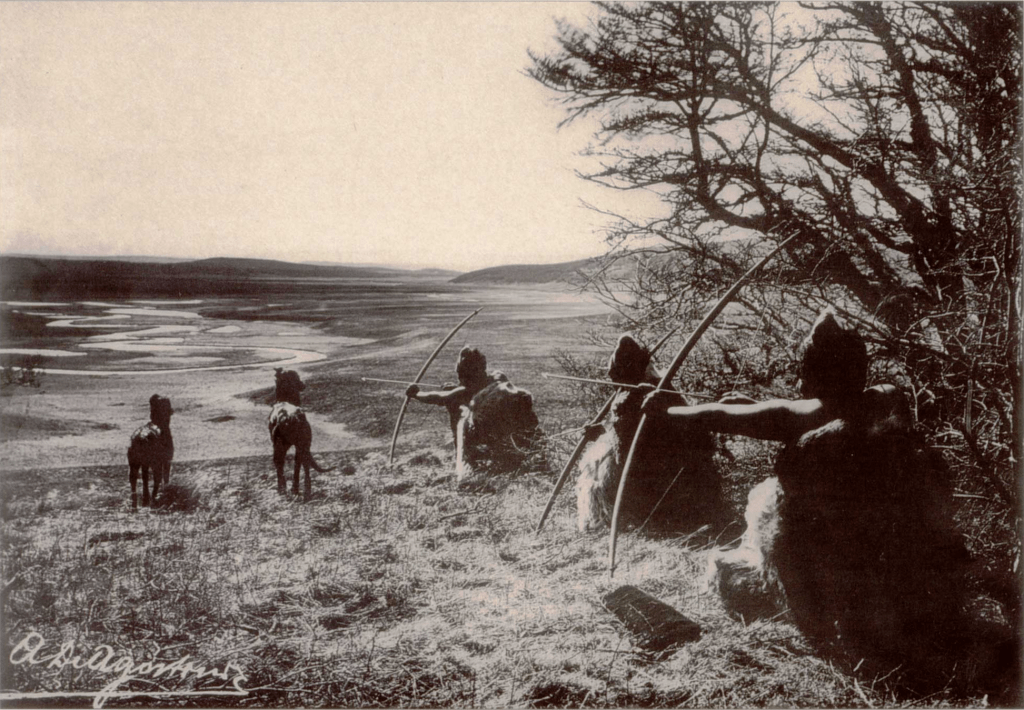
Not much is known for sure about the Fuegian dogs and much of what is known is still being heavily debated. Fuegian Dogs are thought to be a domesticated species of culpeo a fox-like canid of South America while not a true fox they fit an ecological role similar to foxes and coyotes in North America but are more closely related to wolves and jackals. They mostly hunt small game but have been known to occasionally pray on sheep and baby Vicuñas (the wild ancestor of alpacas). (“Fuegian Dog” Wikipedia)

They were used by the various Fuegian peoples as companions to keep warm through the harsh winters of Patagonia. Some reports indicate they were used to hunt Guanacos (Another wild camelid related to llamas) and other small game (“Fuegian Dog” Wikipedia). In 2013 Romina Petrigh and Martín Fugassa conducted DNA research on the remains of a Fuegian Dog held by the Fagnano Regional Museum. Their research concluded that Fuegian dogs had a 97.57% genetic similarity to culpeos and only an 88.93% similarity to domestic dogs. (Petrigh and Fugassa)
In 2023, Fabian M. Jaksic and Sergio A. Castro attempted to refine the language used to describe the dogs used by the indigenous people in the region. They defined the Fuegian Dogs as typical domestic dogs descended from the pre-Columbian dogs maintained by most indigenous people of the Americas. While they define Patagonian dogs as the semi domesticated culpeos. (Dasilva et al.)
Unfortunately the Fuegian dogs along with many of their Fuegian owners were victims a genocidal campaign by Chilean an Argentinian settlers and miners. (“Fuegian Dog” Wikipedia)
Other Similar Domestication Attempts and possible connections
Several other species are suspected to be domesticated or semi domesticated species of culpeos or South American Foxes. While these cases are not as well documented it is interesting to explore the possibility of several species of dog-like canids in South America.
Dusicyon avus
Dusicyon avus is a species of cerdocyonine, a sub-tribe of canines native to South America that went extinct between 300-500 years ago. While not a culpeo they are related and do share some similar physical characteristics.(“Dusicyon Avus” Wikipedia) We don’t know much about these animals but we know that there are at least two examples of them being buried with humans and isotopic analysis indicate they ate human food. (Prates) (Abbona et al.,)

This doesn’t necessarily mean that Dusicyon avus was tamed or domesticated. There could be many reasons why the indiginous people of south America might have buried someone with a wild animal including ritual, religious and magical believes or simply because that particular individual was personally fond of the animal.
While we don’t know for sure the history of the Fuegian dog certainly leaves the door open for further research in this area.
Falkland Islands wolf (Dusicyon australis)
While commonly called a wolf, the Falkland’s Island Wolf is actually a species of Cerdocyonina most closely related to Dusicyon avus. (“Falkland Islands Wolf” Wikipedia)
Mistaking these animals for wolves might have been an easy mistake for early European settlers to make. They would have been a completely new type of canine to the European explorers and they are comparable in size to a small wolf or coyote.
Due to the long distance between the Falkland Islands and the South American mainland and some reports indicating that the Falkland Island Wolves were friendly or at least not fearful of humans. It has been suspected that the animals may have been introduced at some point by the Indigenous people of South America. (Masson-MacLean et al.)

However there is little evidence of the Indigenous people of South America arriving on the island prior to being brought there by colonial authorities and missionaries in the 1800s. (“History of the Falkland Islands” Wikipedia )
Additionally genetic evidence suggests that the Falkland Islands Wolf was very genetically diverse with mtDNA sequencing showing that the animals tested last shared a common ancestor 330,000 years ago. (Slater et al.)
If this is true then it would be unlikely they were brought to the Falklands by humans and might have instead cross via an ice bridge or drifted there on a natural raft of floating derby after a storm. (Slater et al.)
The Falklands Island Wolf met it’s end like its distant cousin the Fuegian dog through a combination of the fur trade and intentional eradication by shepherds who saw them as a nuisance animal. (“Falkland Islands Wolf” Wikipedia)
Citations
Wikipedia contributors. “Falkland Islands Wolf.” Wikipedia, 11 Dec. 2024, en.wikipedia.org/wiki/Falkland_Islands_wolf. Accessed 11 Dec. 2024.
Slater, Graham J., et al. “Origins of the Falklands Wolf.” Current Biology, vol. 19, no. 20, 2009, pp. R937–R938. Elsevier, doi:10.1016/j.cub.2009.08.052.
Wikipedia contributors. “History of the Falkland Islands.” Wikipedia, 11 Dec. 2024, en.wikipedia.org/wiki/History_of_the_Falkland_Islands#Claims_of_pre-Columbian_discovery. Accessed 11 Dec. 2024.
Masson-MacLean, E., et al. “Pre-Columbian Exploration and Colonization of the Falkland Islands: An Analysis of Archaeological and Genetic Evidence.” PLoS ONE, vol. 16, no. 10, 2021, e0259003. PubMed Central, doi:10.1371/journal.pone.0259003.
Prates, Luciano. “Crossing the Boundary between Humans and Animals: The Extinct Fox Dusicyon Avus from a Hunter-Gatherer Mortuary Context in Patagonia (Argentina).” Antiquity 88.342 (2014)
Wikipedia contributors. “Dusicyon Avus.” Wikipedia, 11 Dec. 2024, en.wikipedia.org/wiki/Dusicyon_avus. Accessed 11 Dec. 2024.
Wikipedia contributors. “Fuegian Dog.” Wikipedia, 11 Dec. 2024, en.wikipedia.org/wiki/Fuegian_dog. Accessed 11 Dec. 2024.
Petrigh, Romina S., and Martín H. Fugassa. “Molecular Identification of a Fuegian Dog Belonging to the Fagnano Regional Museum Ethnographic Collection, Tierra del Fuego.” Quaternary International, 2013. Accessed via Web Archive, 20 Dec. 2016, web.archive.org.
Dasilva, Lorena C., et al. “Mitochondrial DNA Suggests a Complex Evolutionary History of Fuegian Dogs.” Revista Chilena de Historia Natural, vol. 96, no. 1, 2023, article 119, doi:10.1186/s40693-023-00119-z.
 Strange cases of domestication
Leave a comment