
Lithic analysis is one of the most important tools paleo archeologists have in understanding the distant past. This is primarily due to the issues in preservation when looking at human artifacts going back tens of thousands or even hundreds of thousands of years.
On such large timescales very little remains, bones, stone tools, pottery, occasionally some wood or other biological material but the further down we dig the less we find. This has forced researchers to get creative to make sure we really get the most out of every piece of napped flint we find documenting even the tiniest chips of stone flaked off and discarded by our Paleolithic ancestors. Developing a wide range of methods to study and categorize lithics.
Archeologists have also developed a many theories on how these stone tools were used for hunting, crafting, and foraging. Among the hunting methods proposed there is a significant amount of scholarship devoted to the concept of “cooperative hunting”. Often this means large groups of hunters driving game, relying primarily on team work, planning and knowledge of the landscape to hunt their query. And this certainly happened, whether it’s a buffalo jump on the great plains of America, corralling gazelle in Jordan or a modern deer drive in Arkansas. Humans tend to be very corporative when hunting big game. But were we always?
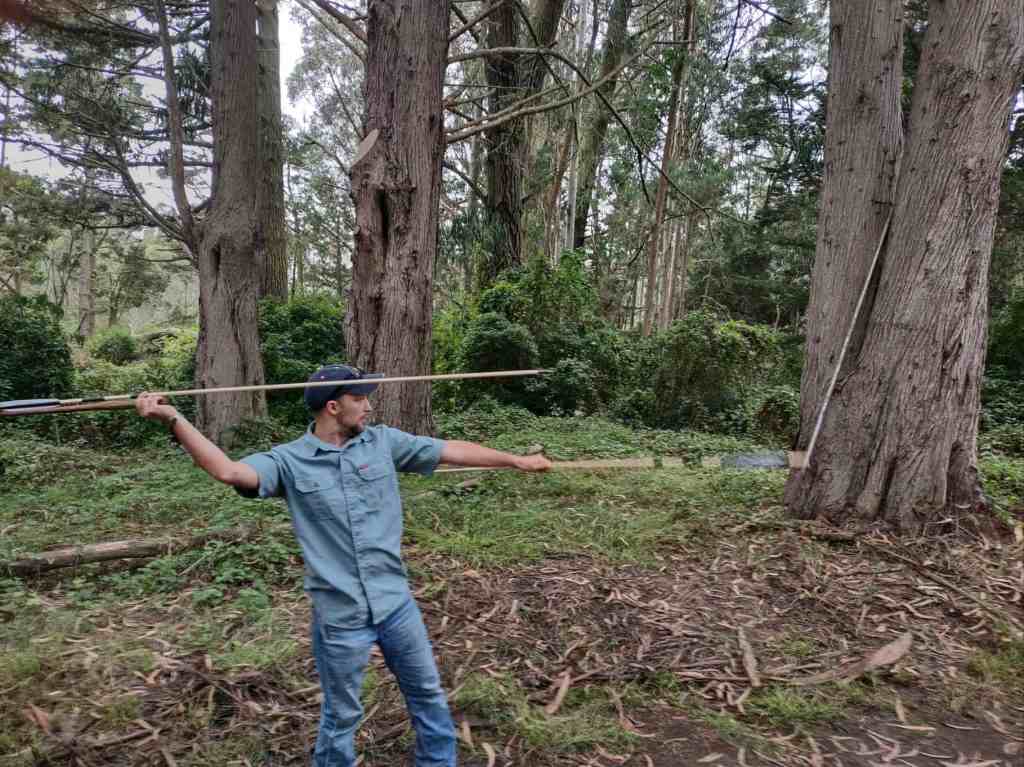
Ryan Gill, Hunt Primitive
Back home in Texas when we say someone “hunts the old way” we usually mean they don’t use four wheelers and automated game cameras. Sometimes this might also mean they use a muzzle loader or bow. But when I say Mr. Gill “hunts the old way” I mean Paleolithic rock art old! Ryan Gills is the owner of Hunt Primitive, a company aimed at educating and inspiring American to take up hunting by primitive methods. He is part of a growing community of American hunters that are trying to get back to basics so to speak by reviving ancient stone tools, traditional bows, and even atlatls.
This hobby goes beyond bagging a few rabbits. Two years ago Mr. Gills was able to bring down an American Bison with an atlatl. To my knowledge this is the first time anyone has brought down an animal that size with a Paleolithic toolkit on film. He then went on to process the animal entirely with stone tools.
For me this really changed the way I look at ancient hunters, if Mr. Gills was able to bring down a bison entirely using Paleolithic tools. What could our ancestors have done. Could they have hunted megafauna solo? Mr. Gills claims they could have, the tools themselves seem perfectly capable of it as his atlatl dart punched right through both sides of the bison.
Spears, Pikes and UC Berkeley
Researchers at UC Berkeley suggest that mammoths could have been hunted with long pikes braced against the ground so that charging mammoths would impale themselves. Similar to how pike formations fought off cavalry in the middle ages (Jason Pohl 2024). The idea is that making clovis points took so much effort that it would have been very costly to waste them by throwing unless you could guarantee the kill (Byram, Lightfoot, and Sunseri 2024). And their lab testing indicates they certainly could have killed a mammoth this way, similar methods may have been used in Europe. But possible doesn’t make it practical, we can test these theories in the lab all we like but without real world hunts it’s difficult to know for sure. And without wild mammoths this will likely always be impossible.
But hope is not lost, in the United States alone we have 3.7 million bow hunters as estimated by the Archery Trade Association. That is 3.7 million potential research assistants that experimental archeologists could draw on. Very few hunt with Paleolithic tools like Mr. Gill but by teaming up with guys like Gill archeologists could help create a small army of experienced woodsmen, armed with Paleolithic toolkits, to go out into the woods and see what works. We might never know how our Paleolithic ancestors hunted whooly mammoths. But we can find out how they hunted whitetail.
Sources
Pohl, Jason. “To Kill Mammoths in the Ice Age, People Used Planted Pikes, Not Throwing Spears, Researchers Say.” Berkeley News, 21 Aug. 2024, https://news.berkeley.edu/2024/08/21/to-kill-mammoths-in-the-ice-age-people-used-planted-pikes-not-throwing-spears-researchers-say/.
Byram, R. Scott, Kent G. Lightfoot, and Jun Ueno Sunseri. “Clovis Points and Foreshafts under Braced Weapon Compression: Modeling Pleistocene Megafauna Encounters with a Lithic Pike.” PLOS ONE, vol. 19, no. 8, 21 Aug. 2024, e0307996. https://doi.org/10.1371/journal.pone.0307996.
Gasaway, Cassie. “2021 State-by-State Hunting Data, 3.7 Million Bowhunters in America.” Archery Trade Association, 16 Mar. 2022, https://archerytrade.org/2021-state-by-state-hunting-data-3-7-million-bowhunters-in-america/.
Gill, Ryan. “Meet Ryan Gill.” Gill’s Primitive Archery, https://gillsprimitivearchery.com/about/. Accessed 10 May 2025.
Gill, Ryan. “Clovis Bison Hunt & Butcher (Newer).” HuntPrimitive, 13 Jul. 2023. YouTube, https://www.youtube.com/watch?v=i2egufzDHok.
 Strange cases of domestication
Leave a comment