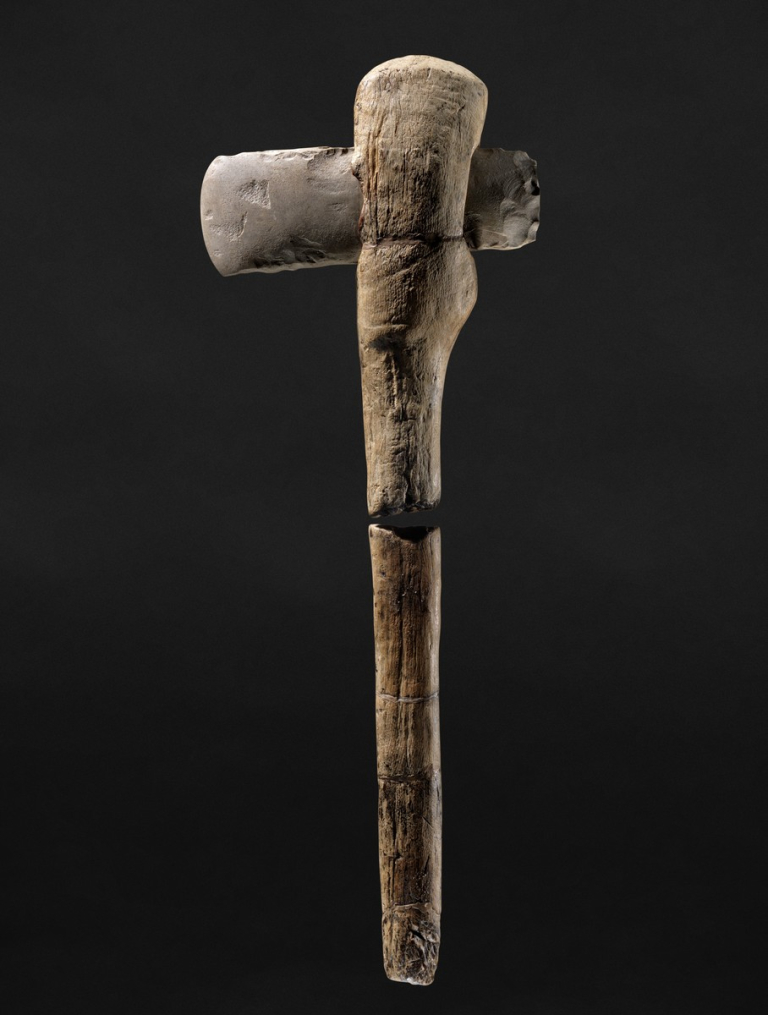
“If you could only have one tool?” growing up around many woodsmen, hunters and fishermen this simple phrase was the source of many heated debates between men in my circle as a kid. Some said a machete, others a knife or multi-tool and some claimed it was an axe or hatchet. In Texas where I grew up any of these tools could have certainly proved useful in the woods and each had their pros and cons. But in the Neolithic I doubt there was much debate on the utility of a good polished axe.
The Neolithic Package

Complex and time consuming products like polished stone axes were pointed to by archeologist Vere Gordon Childe as part of his “neolithic package”. Technological and cultural tools that he believed arrived in Europe from the East creating the neolithic revolution and urbanization. The specifics of this are now heavily debated but the axes themselves remain an example of the craftsmanship of ancient peoples and prehistoric long distance trade.
A photograph taken of the noted archaeologist and socialist V. Gordon Childe, circa 1930s. Swan Watson, Andrew – The National Library of Australia (http://nla.gov.au/nla.pic-an23815428)
How they were made
While there was likely many methods to make stone axes for various purposes or variations by different craftsmen in regions Dr. James Dilley showcases one of the most well researched methods of crafting stone axes. This was done by flaking large pieces of flint or porcellanite into blanks that would be further shaped by grinding the blank against a rough, wet stone until it slowly reached the desired shape.
How they were used
Use of stone axes in practice can be much less forgiving and even a bit dangerous for the untrained user, especially when compared to modern steal axes. A bad chop or “side-slap” can easily break the axe so the cuts much be more direct, stone axes also seem to throw chunks of wood more often then steal axes. Larry Kinsella experimental archeologist and woodmen demonstrates how a skilled user can work the axe almost as effectively as a modern axe. Even going so far as to organize events to “chip-a-canoe” to build a canoe from scratch with stone tools.
How they were traded
Dr. Peter Rowley-Conwy in his 2011 paper “Westward Ho! The Spread of Agriculture from Central Europe to the Atlantic” discusses how the movement of trade goods like polished axes was extensive especially between settled farmers and hunter-gatherers. With the farmers migrating into Northern Europe with these stone axes, continued trade between the of stone axes between the two groups for thousands of years before the widespread reliance on agriculture in Europe.
Sources
Roberts, Patrick, and Mark W. Moore. “Hafted Axe (Replicated).” Museum of Stone Tools, https://stonetoolsmuseum.com/artefact/europe/hafted-axe-replicated/5664/.
“V. Gordon Childe.” Wikipedia: The Free Encyclopedia, Wikimedia Foundation, 5 May 2025, https://en.wikipedia.org/wiki/V._Gordon_Childe.
Dilley, James. “Porcellanite Axeheads: Neolithic Tools in Northern Ireland.” YouTube, uploaded by AncientCraftUK – Dr. James Dilley, 15 June 2015, https://www.youtube.com/watch?v=oTnu0n11JKY.
Kinsella, Larry. “Chip-A-Canoe and a Few Blisters Too.” YouTube, uploaded by Cahokia Archaeological Society, 17 Nov. 2023, https://www.youtube.com/watch?v=IT3N0_20d30.
Rowley-Conwy, Peter. “Westward Ho! The Spread of Agriculturalism from Central Europe to the Atlantic.” Current Anthropology, vol. 52, no. S4, 2011, pp. S431–S451. The University of Chicago Press on behalf of the Wenner-Gren Foundation for Anthropological Research, https://www.jstor.org/stable/10.1086/658368.
Kinsella, Larry. “Rabbitstick 2012 Axe and Celts.” YouTube, uploaded by Leland Gilsen, 11 June 2017, https://www.youtube.com/watch?v=GvEp6aTZbLk.
 Strange cases of domestication
Leave a comment