In 2008 Michael Shunkov from the Russian Academy of Sciences made the first discovery of Denisovans, from just a finger bone in Denisovia cave Siberia. While a finger bone by itself might not normally off much data, researchers were able to extract enough preserved DNA to identify a new piece of the human lineage. Over following years several more specimens were found in Russia, China, Laos and Taiwan. (Wikipedia, Denisovans)
Unfortunately no complete skeleton has yet been found, but the DNA present provides an interesting picture of modern humans interaction with both Denisovans and Neanderthals. With Denny (Denisova 11) being the offspring of a Denisovan father and Neanderthal mother around 90,000 years ago (Warren 2018). As well as well as evidence of interbreeding with modern humans with some studies indicating that certain populations in South East Asia and Oceania carry up to 6% Denisovan DNA. (Reich 2010)
Continuing muddle
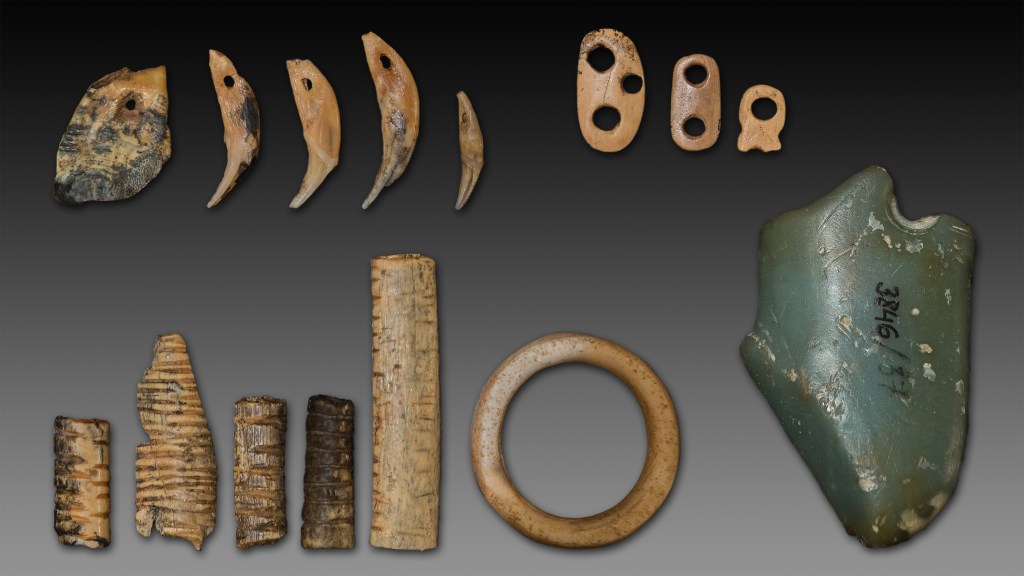
The above picture shows a few of the many artifacts found at Denisova cave including jade bracelets, carved mammoth bones and tooth beads. While it is certainly possible that some of these artifacts are from our Denisovan cousins many might be from human sapiens or Neanderthals as all three species are known to have lived in the cave at various times. (Wikipedia, Denisova Cave)
The DNA makes things even more confusing, with Denisovans interbreeding with multiple Neanderthal populations and other unknown archaic human populations likely homo hiedelberginisous or homo erectus. Neanderthals also interbred with such species at various times. This creates a “muddle in the middle” as Harvat described in 2022 and it seems to get more muddled every year as we continue to explore the DNA. (Harvati and Reyes-Centeno)
The complexities of the DNA found along with the lack of skeletal or material findings have caused Denisovans to be a popular topic of online conspiracy theories or at the very least, creative leaps in judgement without data to support it (Often known as fringe theories).
Due to the fact that many of these online conspiracy theories regarding Denisovans are created to justify racism I will not show them here. But the linked video provides an example of one of these fringe theories from Graham Hancock.
Obviously Hancock is making a bit of a leap here and due to the mysteries surrounding Denisovans it’s become earsier to find fringe theories then hard data online. This unfortunately will probably continue until we have more data available, fringe theories like this only further the muddle Harvat describes with new data being buried online behind misinformation.
Sources
Harvati, Katerina, and Hugo Reyes-Centeno. “Evolution of Homo in the Middle and Late Pleistocene.” Journal of Human Evolution, vol. 173, 2022, article 103279. Elsevier, https://doi.org/10.1016/j.jhevol.2022.103279.
“Denisovan.” Wikipedia: The Free Encyclopedia, Wikimedia Foundation, 10 May 2025, https://en.wikipedia.org/wiki/Denisovan.
Warren, Matthew. “First Ancient-Human Hybrid.” Nature, vol. 560, no. 7719, 23 Aug. 2018, pp. 417–418. https://doi.org/10.1038/d41586-018-06004-0.
Hancock, Graham. “Graham Hancock about Mysterious Bracelet Found in Denisova Cave.” The Joe Rogan Experience, uploaded by ShortcastCentral, 4 Nov. 2023. YouTube, https://www.youtube.com/watch?v=fR09hgqJCHc.
 Strange cases of domestication
Leave a comment