In 2008 Michael Shunkov from the Russian Academy of Sciences made the first discovery of Denisovans, from just a finger bone in Denisovia cave Siberia. While a finger bone by itself might not normally off much data, researchers were able to extract enough preserved DNA to identify a new piece of the human lineage. Over following years several more specimens were found in Russia, China, Laos and Taiwan. (Wikipedia, Denisovans)
Unfortunately no complete skeleton has yet been found, but the DNA present provides an interesting picture of modern humans interaction with both Denisovans and Neanderthals. With Denny (Denisova 11) being the offspring of a Denisovan father and Neanderthal mother around 90,000 years ago (Warren 2018). As well as well as evidence of interbreeding with modern humans with some studies indicating that certain populations in South East Asia and Oceania carry up to 6% Denisovan DNA. (Reich 2010)
Continuing muddle
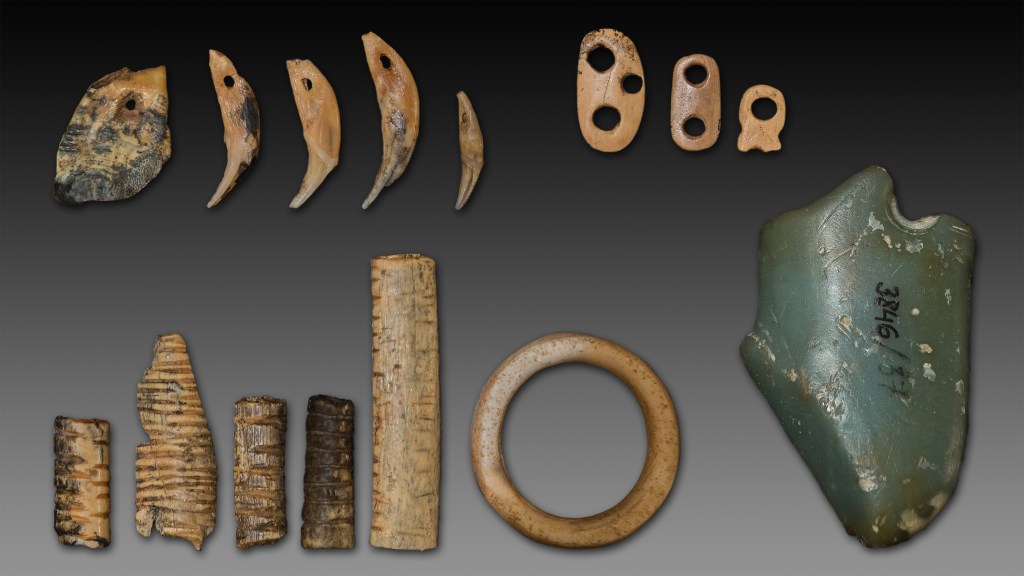
Ring, pendant, pearls and notched bone artifacts from Denisova Cave, exhibited in the special exhibition “Le troisième Homme” (June 30, 2017 to November 13, 2017) in the Musée national de Préhistoire in Les Eyzies-de-Tayac, France. Thilo Parg
The above picture shows a few of the many artifacts found at Denisova cave including jade bracelets, carved mammoth bones and tooth beads. While it is certainly possible that some of these artifacts are from our Denisovan cousins many might be from human sapiens or Neanderthals as all three species are known to have lived in the cave at various times. (Wikipedia, Denisova Cave)
The DNA makes things even more confusing, with Denisovans interbreeding with multiple Neanderthal populations and other unknown archaic human populations likely homo hiedelberginisous or homo erectus. Neanderthals also interbred with such species at various times. This creates a “muddle in the middle” as Harvat described in 2022 and it seems to get more muddled every year as we continue to explore the DNA. (Harvati and Reyes-Centeno)
The complexities of the DNA found along with the lack of skeletal or material findings have caused Denisovans to be a popular topic of online conspiracy theories or at the very least, creative leaps in judgement without data to support it (Often known as fringe theories).
Due to the fact that many of these online conspiracy theories regarding Denisovans are created to justify racism I will not show them here. But the linked video provides an example of one of these fringe theories from Graham Hancock.
Obviously Hancock is making a bit of a leap here and due to the mysteries surrounding Denisovans it’s become earsier to find fringe theories then hard data online. This unfortunately will probably continue until we have more data available, fringe theories like this only further the muddle Harvat describes with new data being buried online behind misinformation.
Sources
Harvati, Katerina, and Hugo Reyes-Centeno. “Evolution of Homo in the Middle and Late Pleistocene.” Journal of Human Evolution, vol. 173, 2022, article 103279. Elsevier, https://doi.org/10.1016/j.jhevol.2022.103279.
Hancock, Graham. “Graham Hancock about Mysterious Bracelet Found in Denisova Cave.” The Joe Rogan Experience, uploaded by ShortcastCentral, 4 Nov. 2023. YouTube, https://www.youtube.com/watch?v=fR09hgqJCHc.
“If you could only have one tool?” growing up around many woodsmen, hunters and fishermen this simple phrase was the source of many heated debates between men in my circle as a kid. Some said a machete, others a knife or multi-tool and some claimed it was an axe or hatchet. In Texas where I grew up any of these tools could have certainly proved useful in the woods and each had their pros and cons. But in the Neolithic I doubt there was much debate on the utility of a good polished axe.
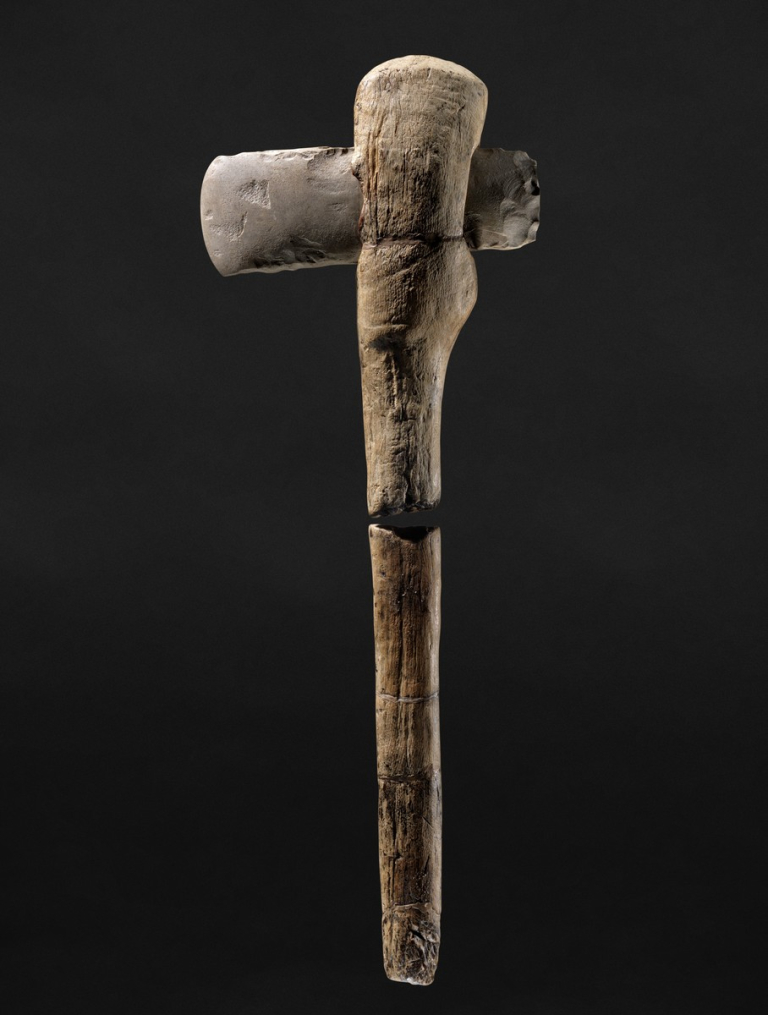
Hafted axe from Neolithic Denmark, discovered in Stormose near Borum, Aarhus, during peat digging in 1946. Photograph by R. N. Johansen, Moesgaard Museum.
The Neolithic Package
Complex and time consuming products like polished stone axes were pointed to by archeologist Vere Gordon Childe as part of his “neolithic package”. Technological and cultural tools that he believed arrived in Europe from the East creating the neolithic revolution and urbanization. The specifics of this are now heavily debated but the axes themselves remain an example of the craftsmanship of ancient peoples and prehistoric long distance trade. A photograph taken of the noted archaeologist and socialist V. Gordon Childe, circa 1930s. Swan Watson, Andrew – The National Library of Australia (http://nla.gov.au/nla.pic-an23815428)
How they were made
While there was likely many methods to make stone axes for various purposes or variations by different craftsmen in regions Dr. James Dilley showcases one of the most well researched methods of crafting stone axes. This was done by flaking large pieces of flint or porcellanite into blanks that would be further shaped by grinding the blank against a rough, wet stone until it slowly reached the desired shape.
How they were used
Use of stone axes in practice can be much less forgiving and even a bit dangerous for the untrained user, especially when compared to modern steal axes. A bad chop or “side-slap” can easily break the axe so the cuts much be more direct, stone axes also seem to throw chunks of wood more often then steal axes. Larry Kinsella experimental archeologist and woodmen demonstrates how a skilled user can work the axe almost as effectively as a modern axe. Even going so far as to organize events to “chip-a-canoe” to build a canoe from scratch with stone tools.
How they were traded
Dr. Peter Rowley-Conwy in his 2011 paper “Westward Ho! The Spread of Agriculture from Central Europe to the Atlantic” discusses how the movement of trade goods like polished axes was extensive especially between settled farmers and hunter-gatherers. With the farmers migrating into Northern Europe with these stone axes, continued trade between the of stone axes between the two groups for thousands of years before the widespread reliance on agriculture in Europe.
Dilley, James. “Porcellanite Axeheads: Neolithic Tools in Northern Ireland.” YouTube, uploaded by AncientCraftUK – Dr. James Dilley, 15 June 2015, https://www.youtube.com/watch?v=oTnu0n11JKY.
Rowley-Conwy, Peter. “Westward Ho! The Spread of Agriculturalism from Central Europe to the Atlantic.” Current Anthropology, vol. 52, no. S4, 2011, pp. S431–S451. The University of Chicago Press on behalf of the Wenner-Gren Foundation for Anthropological Research, https://www.jstor.org/stable/10.1086/658368.
Lithic analysis is one of the most important tools paleo archeologists have in understanding the distant past. This is primarily due to the issues in preservation when looking at human artifacts going back tens of thousands or even hundreds of thousands of years.
On such large timescales very little remains, bones, stone tools, pottery, occasionally some wood or other biological material but the further down we dig the less we find. This has forced researchers to get creative to make sure we really get the most out of every piece of napped flint we find documenting even the tiniest chips of stone flaked off and discarded by our Paleolithic ancestors. Developing a wide range of methods to study and categorize lithics.
Archeologists have also developed a many theories on how these stone tools were used for hunting, crafting, and foraging. Among the hunting methods proposed there is a significant amount of scholarship devoted to the concept of “cooperative hunting”. Often this means large groups of hunters driving game, relying primarily on team work, planning and knowledge of the landscape to hunt their query. And this certainly happened, whether it’s a buffalo jump on the great plains of America, corralling gazelle in Jordan or a modern deer drive in Arkansas. Humans tend to be very corporative when hunting big game. But were we always?
Ryan Gill, Hunt Primitive
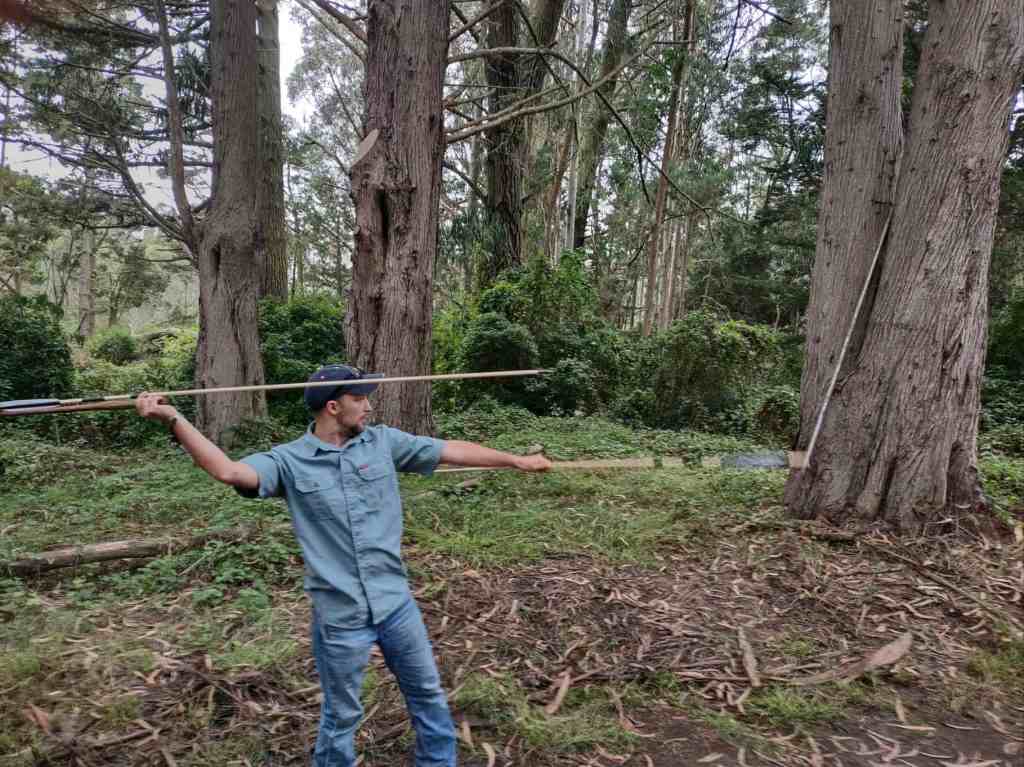
Back home in Texas when we say someone “hunts the old way” we usually mean they don’t use four wheelers and automated game cameras. Sometimes this might also mean they use a muzzle loader or bow. But when I say Mr. Gill “hunts the old way” I mean Paleolithic rock art old! Ryan Gills is the owner of Hunt Primitive, a company aimed at educating and inspiring American to take up hunting by primitive methods. He is part of a growing community of American hunters that are trying to get back to basics so to speak by reviving ancient stone tools, traditional bows, and even atlatls.
This hobby goes beyond bagging a few rabbits. Two years ago Mr. Gills was able to bring down an American Bison with an atlatl. To my knowledge this is the first time anyone has brought down an animal that size with a Paleolithic toolkit on film. He then went on to process the animal entirely with stone tools.
For me this really changed the way I look at ancient hunters, if Mr. Gills was able to bring down a bison entirely using Paleolithic tools. What could our ancestors have done. Could they have hunted megafauna solo? Mr. Gills claims they could have, the tools themselves seem perfectly capable of it as his atlatl dart punched right through both sides of the bison.
Spears, Pikes and UC Berkeley
Researchers at UC Berkeley suggest that mammoths could have been hunted with long pikes braced against the ground so that charging mammoths would impale themselves. Similar to how pike formations fought off cavalry in the middle ages (Jason Pohl 2024). The idea is that making clovis points took so much effort that it would have been very costly to waste them by throwing unless you could guarantee the kill (Byram, Lightfoot, and Sunseri 2024). And their lab testing indicates they certainly could have killed a mammoth this way, similar methods may have been used in Europe. But possible doesn’t make it practical, we can test these theories in the lab all we like but without real world hunts it’s difficult to know for sure. And without wild mammoths this will likely always be impossible.
But hope is not lost, in the United States alone we have 3.7 million bow hunters as estimated by the Archery Trade Association. That is 3.7 million potential research assistants that experimental archeologists could draw on. Very few hunt with Paleolithic tools like Mr. Gill but by teaming up with guys like Gill archeologists could help create a small army of experienced woodsmen, armed with Paleolithic toolkits, to go out into the woods and see what works. We might never know how our Paleolithic ancestors hunted whooly mammoths. But we can find out how they hunted whitetail.
Byram, R. Scott, Kent G. Lightfoot, and Jun Ueno Sunseri. “Clovis Points and Foreshafts under Braced Weapon Compression: Modeling Pleistocene Megafauna Encounters with a Lithic Pike.” PLOS ONE, vol. 19, no. 8, 21 Aug. 2024, e0307996. https://doi.org/10.1371/journal.pone.0307996.
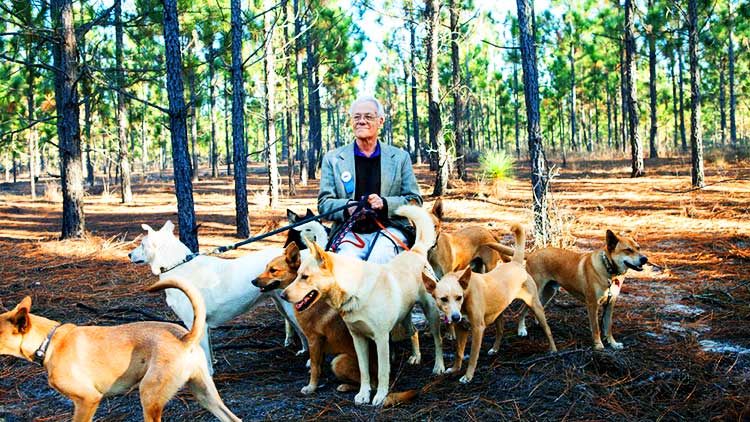
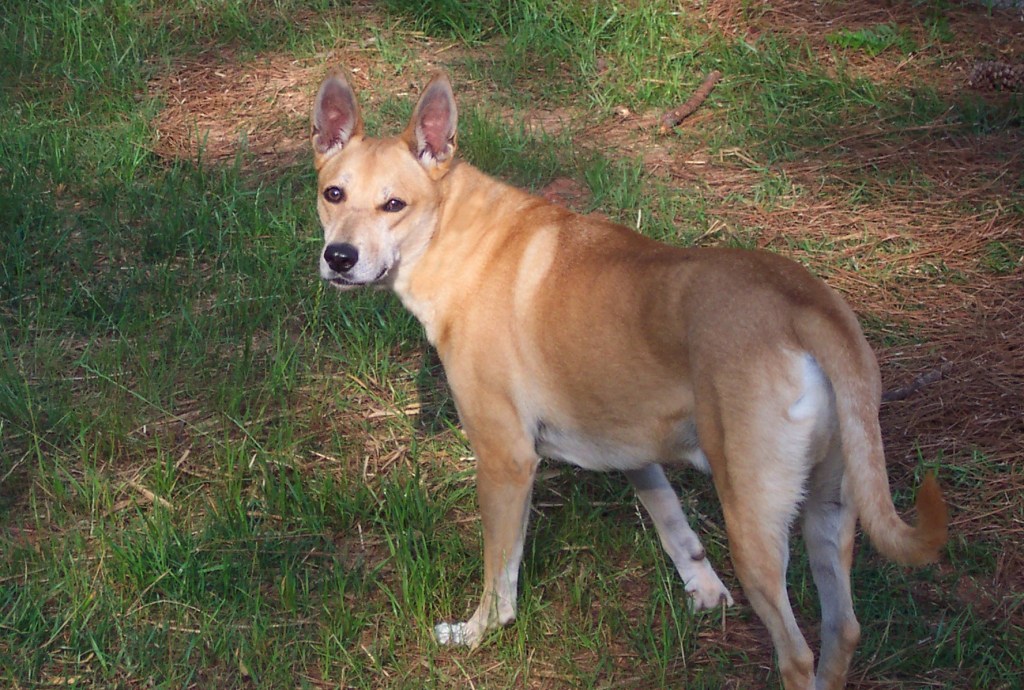
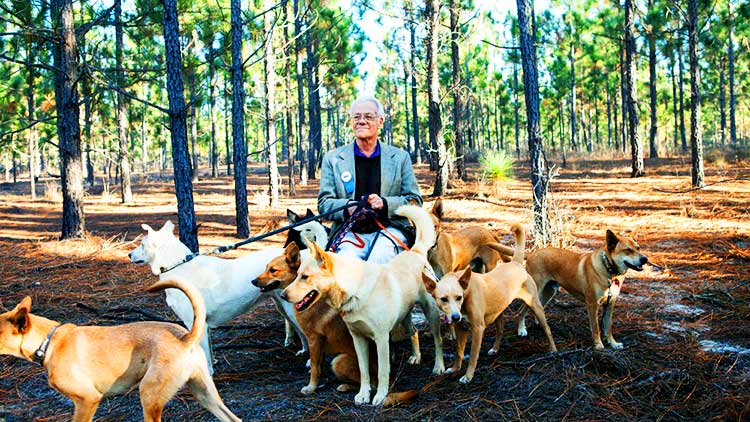
The Carolina Dog is a feral or semi feral landrace of dogs native to the South East United States, mostly in Georgia and Carolina. Commonly called the American dingo due to their similar appearance the Carolina Dog is unrelated to Austrialian Dingos. Representing a unique line of wild dogs found only in the United States.
While various groups of feral dogs are not by any means uncommon in the American South and have existed for hundreds of years, likely long before the arrival of European settlers. The author himself recalls many packs of feral dogs in rural areas of Texas, Louisiana, Arkansas and Oklahoma. These dogs are typically descended of strays, usually rely on human settlements for food and are often thought of as pests no different then the feral pigs that are so common in the same areas.
Carolina dog “Hunter” in Calabash, North Carolina that participated in DNA testing to establish ancient origin of the species. 13 March 2013 Calabash13
These dogs tend to run in packs and come from a variety of breeds but overtime some groups will start to become more genetically isolated and form a “landrace”. Where the dogs in a given area will become more genetically similar, exhibiting a common set of physical characteristics and behaviors. These landraces of wild dogs often don’t last long as they’re often exterminated or removed as pests. Genetic admixture from other dog lines prevents them from maintaining the genetic isolation necessary to maintain shared characteristics.
What makes the modern Carolina dog is unique due to a large portion of their genetic makeup being from the dogs used by Indigenous people of the South Eastern United States. As well as their ability to survive in remote areas without reliance on human settlement to supply them with food. (Brisbin and Risch, 1997)
Historically these dogs were often referred to as “Indian dogs” or aboriginal dogs (Cope 1863). Not much thought was given by ethnologists and biologists to these dogs until Dr. I. Lehr Brisbin lead ecologist of University of Georgia’s Savannah River Ecology Laboratory which studies the area around the Savannah River Nuclear Site. This site covers 310 square miles, area is almost completely depopulated and sealed off from trespassers which has allowed the Carolina dog to thrive (Brisbin and Risch, 1997).
They survive by hunting small to medium prey including shrews, raccoons, mice and reptiles with a tendency to pounce on prey like a fox. Reproductively the Carolina dog exhibits three successive estrus cycles which often settle into seasonal patterns when there’s an abundance of puppies. It is thought that this quick breeding enables Carolina dogs to reproduce quickly enough to sustain their population in the face of diseases, parasites and other challenges of living in the wild. Male Carolina dogs have also been observed to stay with their puppies and play a more active role then other dogs (Primitive Dogs).
In regards to DNA there have been mixed results. One 2013 study on mitochondrial DNA indicated that 37% carried a unique haplotype (A184), which had not been previously documented and is related to the a5 mtDNA sub-haplogroup that came from East Asia (Boyko and vonHoldt).
Another study in 2018 included three individual Carolina dogs showed a 0%-33% admixture from pre-Columbian dogs or from Arctic dogs. The study had no available method to identify the difference between these two groups and with only three dogs tested more research is certainly necessary to access the true genetic origins of this unique American dog. As a result some researchers believe that it may not have any pre-Columbian Dog DNA but the unique (A184) haplotype makes this seem unlikely. (Ní Leathlobhair et al. 81)
Works Cited
Ní Leathlobhair, Máire, et al. “The Evolutionary History of Dogs in the Americas.” Science, vol. 361, no. 6397, 2018, pp. 81–85. PubMed Central, https://pmc.ncbi.nlm.nih.gov/articles/PMC7116273/. Accessed 15 Dec. 2024.
Boyko, Adam R., and Bridgett M. vonHoldt. “Canid Domestication and Population Genomics.” PLOS Genetics, Public Library of Science, 8(8), Aug. 2012, doi:10.1371/journal.pgen.1002892. Accessed 15 Dec. 2024.
Brisbin, Ian L., and Thomas S. Risch. “Primitive Dogs, Their Ecology and Behavior: Unique Opportunities to Study the Early Development of the Human-Canine Bond.” Journal of the American Veterinary Medical Association, May 1997, doi:10.2460/javma.1997.210.8.1122a. Accessed via ResearchGate.
Tim the Historian. “The American Dingo: Carolina Dogs~ History from Home.” YouTube, 30 Apr. 2023, www.youtube.com/watch?v=gwNc9wIO2M4. Accessed 15 Dec. 2024.
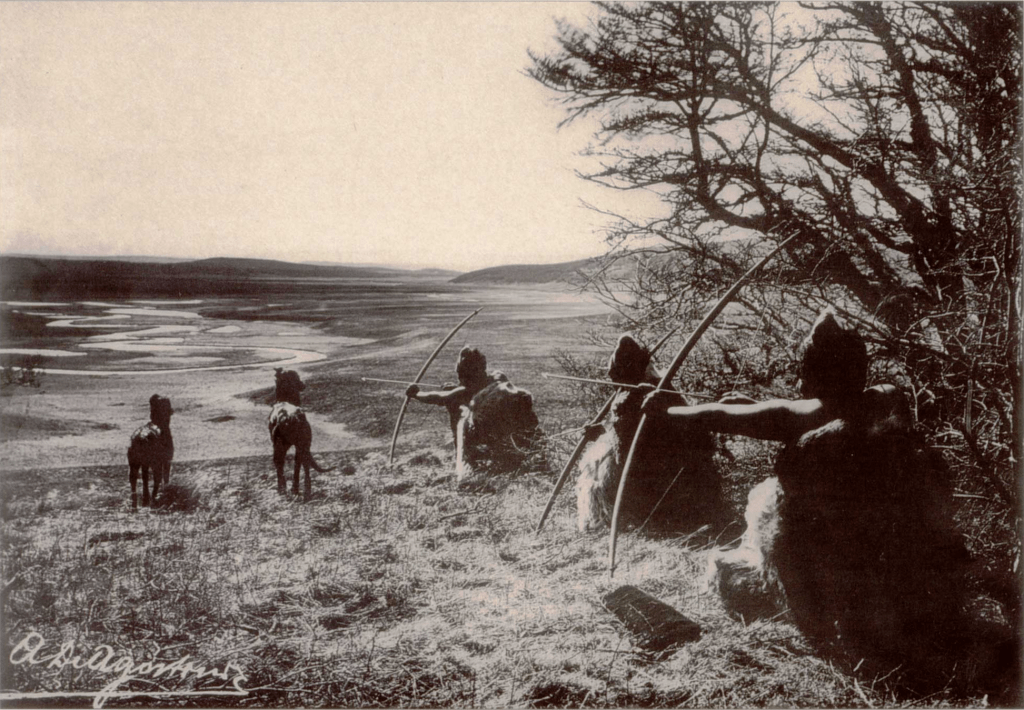
In the strange history of domestication, nothing is both as strange and familiar as the case of South American Foxes such as the culpeo and other fox-like canids like the Dusicyons. While not true foxes these animals maintain many fox-like traits and are very similar in appearance. The Indigenous peoples of South America seem to have made several attempts to domesticate these animals. Most notably the extinct Fuegian dog, a culpeo domesticated by the Fuegian peoples of Patagonia particularly the Selk’nam and Yahgan. (“Fuegian Dog” Wikipedia)
Not much is known for sure about the Fuegian dogs and much of what is known is still being heavily debated. Fuegian Dogs are thought to be a domesticated species of culpeo a fox-like canid of South America while not a true fox they fit an ecological role similar to foxes and coyotes in North America but are more closely related to wolves and jackals. They mostly hunt small game but have been known to occasionally pray on sheep and baby Vicuñas (the wild ancestor of alpacas). (“Fuegian Dog” Wikipedia)
Peru – Colca Canyon – Culpeo – Lycalopex culpaeus – PanAmericana 2017 – the image was taken on an overlanding travel from Ushuaia to Anchorage – taken by Thomas Fuhrmann, SnowmanStudios – see more pictures on / mehr Aufnahmen auf http://www.snowmanstudios.de
They were used by the various Fuegian peoples as companions to keep warm through the harsh winters of Patagonia. Some reports indicate they were used to hunt Guanacos (Another wild camelid related to llamas) and other small game (“Fuegian Dog” Wikipedia). In 2013 Romina Petrigh and Martín Fugassa conducted DNA research on the remains of a Fuegian Dog held by the Fagnano Regional Museum. Their research concluded that Fuegian dogs had a 97.57% genetic similarity to culpeos and only an 88.93% similarity to domestic dogs. (Petrigh and Fugassa)
In 2023, Fabian M. Jaksic and Sergio A. Castro attempted to refine the language used to describe the dogs used by the indigenous people in the region. They defined the Fuegian Dogs as typical domestic dogs descended from the pre-Columbian dogs maintained by most indigenous people of the Americas. While they define Patagonian dogs as the semi domesticated culpeos. (Dasilva et al.)
Unfortunately the Fuegian dogs along with many of their Fuegian owners were victims a genocidal campaign by Chilean an Argentinian settlers and miners. (“Fuegian Dog” Wikipedia)
Other Similar Domestication Attempts and possible connections
Several other species are suspected to be domesticated or semi domesticated species of culpeos or South American Foxes. While these cases are not as well documented it is interesting to explore the possibility of several species of dog-like canids in South America.
Dusicyon avus
Dusicyon avus is a species of cerdocyonine, a sub-tribe of canines native to South America that went extinct between 300-500 years ago. While not a culpeo they are related and do share some similar physical characteristics.(“Dusicyon Avus” Wikipedia) We don’t know much about these animals but we know that there are at least two examples of them being buried with humans and isotopic analysis indicate they ate human food. (Prates) (Abbona et al.,)
photo: Dusicyon avus on Wikipedia by Juandertal 2022
This doesn’t necessarily mean that Dusicyon avus was tamed or domesticated. There could be many reasons why the indiginous people of south America might have buried someone with a wild animal including ritual, religious and magical believes or simply because that particular individual was personally fond of the animal. While we don’t know for sure the history of the Fuegian dog certainly leaves the door open for further research in this area.
Falkland Islands wolf (Dusicyon australis)
While commonly called a wolf, the Falkland’s Island Wolf is actually a species of Cerdocyonina most closely related toDusicyon avus. (“Falkland Islands Wolf” Wikipedia)
Mistaking these animals for wolves might have been an easy mistake for early European settlers to make. They would have been a completely new type of canine to the European explorers and they are comparable in size to a small wolf or coyote.
Due to the long distance between the Falkland Islands and the South American mainland and some reports indicating that the Falkland Island Wolves were friendly or at least not fearful of humans. It has been suspected that the animals may have been introduced at some point by the Indigenous people of South America. (Masson-MacLean et al.)
Warrah or Falkland Island wolf (Dusicyon australis); the specimen held at Otago Museum attributed to Kane Fleury
However there is little evidence of the Indigenous people of South America arriving on the island prior to being brought there by colonial authorities and missionaries in the 1800s. (“History of the Falkland Islands” Wikipedia )
Additionally genetic evidence suggests that the Falkland Islands Wolf was very genetically diverse with mtDNA sequencing showing that the animals tested last shared a common ancestor 330,000 years ago. (Slater et al.)
If this is true then it would be unlikely they were brought to the Falklands by humans and might have instead cross via an ice bridge or drifted there on a natural raft of floating derby after a storm. (Slater et al.)
The Falklands Island Wolf met it’s end like its distant cousin the Fuegian dog through a combination of the fur trade and intentional eradication by shepherds who saw them as a nuisance animal. (“Falkland Islands Wolf” Wikipedia) Citations
Slater, Graham J., et al. “Origins of the Falklands Wolf.” Current Biology, vol. 19, no. 20, 2009, pp. R937–R938. Elsevier, doi:10.1016/j.cub.2009.08.052.
Wikipedia contributors. “History of the Falkland Islands.” Wikipedia, 11 Dec. 2024, en.wikipedia.org/wiki/History_of_the_Falkland_Islands#Claims_of_pre-Columbian_discovery. Accessed 11 Dec. 2024.
Masson-MacLean, E., et al. “Pre-Columbian Exploration and Colonization of the Falkland Islands: An Analysis of Archaeological and Genetic Evidence.” PLoS ONE, vol. 16, no. 10, 2021, e0259003. PubMed Central, doi:10.1371/journal.pone.0259003.
Prates, Luciano. “Crossing the Boundary between Humans and Animals: The Extinct Fox Dusicyon Avus from a Hunter-Gatherer Mortuary Context in Patagonia (Argentina).” Antiquity 88.342 (2014)
Petrigh, Romina S., and Martín H. Fugassa. “Molecular Identification of a Fuegian Dog Belonging to the Fagnano Regional Museum Ethnographic Collection, Tierra del Fuego.” Quaternary International, 2013. Accessed via Web Archive, 20 Dec. 2016, web.archive.org.
Dasilva, Lorena C., et al. “Mitochondrial DNA Suggests a Complex Evolutionary History of Fuegian Dogs.” Revista Chilena de Historia Natural, vol. 96, no. 1, 2023, article 119, doi:10.1186/s40693-023-00119-z.
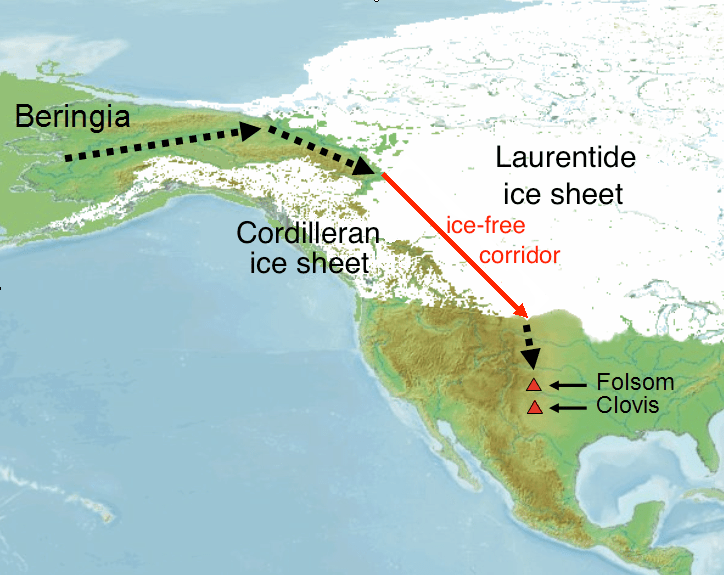
Dogs were crutal to most preindustrial societies including the Native Americans who brought their dogs with them on their journey across the bering straight at least 12,000 years ago. With few animals suited to domestication such as sheep, goats, cows and horses. The indigiousous people of the Americans got creative with their utilization of dogs for far wider variety of tasks then their old world counterparts. Creating specific breeds of dogs to serve highly specified roles. Examples of this include the Alaskan Malamute, Canadian Eskimo Dog and Greenland dog. All of whom were bred for pulling sleds. The Chiribaya Dog bred in Peru for llama herding. And the Techichi which are thought to have mainly been bred by the Aztecs for meat production. This blog will Focus on the stranger cases of canine domestication in the Americas beginning with the Salish Wool Dog.
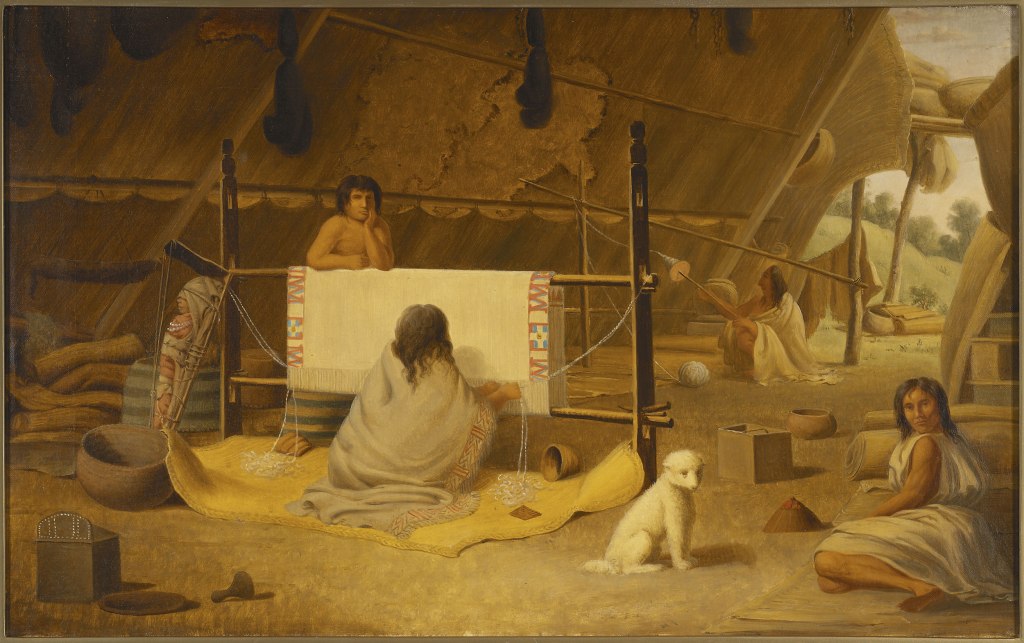
“A Woman Weaving a Blanket,” Songhees/Saanich (Central Coast Salish) Paul Kane (1849-1856)
Salish Wool Dog
The Salish Wool Dog was a breed of dog kept by the Salish people of modern day Washington State and British Columbia. These dogs were selectively bred and maintained mainly for the production of their wool-like hair which was used in the same way sheep’s wool might be used in the old world (American Museum of Natural History 2023). One account by George Vancouver suggests that the wool from Salish dogs was just as good as sheep’s wool as the fleece could be picked up by a single corner after sheering without falling apart. (Salish Wool Dog.” Wikipedia)
This unique trait of wool production is a result of selective breeding and intuitional genetic isolation. One study of Salish Wool Dog led by Audrey Lin used a pelt in the Smithsonian collections to examine their DNA. This study showed that the Salish people were very careful to keep the genetic line of these dogs pure, often isolating them on islands or in caves. (Lin et al. 2023)
Like many species of North America the effects of colonialism proved to be the end of these amazing canines as the Indian Agents, Missionaries and criminalization of indigenous cultural practices led to the extermination of many dogs. This was compounded by the small pox epidemics that killed large numbers of the Salish people, the only caretakers of the dogs. (American Museum of Natural History 2023).
Citations
Lin, Audrey T., et al. “The History of Coast Salish ‘Woolly Dogs’ Revealed by Ancient Genomics and Indigenous Knowledge.” Science, vol. 382, no. 6676, 15 Dec. 2023, pp. 1303–1308, https://doi.org/10.1126/science.adi6549.




 Strange cases of domestication